

O que está por trás da ‘vibração atmosférica induzida’ que afetou a rede de energia na Europa?
2025-04-30Samsung desenvolve tecnologia inovadora para câmeras de smartphones que permite atualizações personalizadas de lentes.
2025-04-30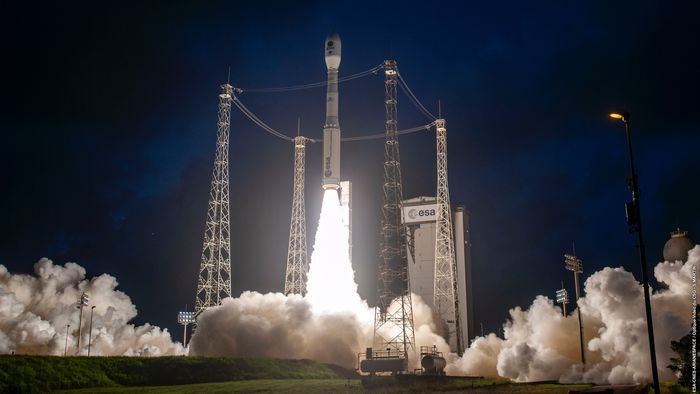
Here is the rewritten text:
Six rockets were launched in less than 24 hours, setting a new record. The launches took place in different locations in the United States, China, and French Guiana, surpassing the previous record of four launches in a single day. Unfortunately, one of the rockets failed.
The first launch occurred on Monday at 15:10 (Brasília time) in China, with the Long March 5B rocket sending a batch of satellites into low Earth orbit (LEO) for the Guowang constellation.
Later that day, a Falcon 9 rocket from SpaceX launched from Vandenberg Air Force Base in California, carrying 27 internet satellites into LEO. Around 20:00, Amazon launched its Atlas V rocket, which is part of the Kuiper Project, sending the first 27 satellites into orbit.
Another Falcon 9 rocket from SpaceX completed the launches on Monday, marking the company’s 250th mission. The rocket carried 23 Starlink satellites into LEO.
From French Guiana to the USA
The last two rockets responsible for the new record were launched on Tuesday. The Vega-C rocket from Arianespace took off from Kourou, French Guiana, at 06:15 (Brasília time) and carried a biomass monitoring satellite into LEO for the European Space Agency (ESA).
LIFTOFF of our Biomass mission on a Vega-C rocket from Europe’s Spaceport in French Guiana! pic.twitter.com/ufvuCf10qc
— European Space Agency (@esa) April 29, 2025
The sixth and final launch was the only one that failed. The Alpha rocket from Firefly Aerospace took off from Vandenberg Air Force Base in California at 10:37, but a problem with the second stage caused it to crash into the Pacific Ocean, along with the LM 400 satellite from Lockheed Martin.
The time between the first launch and the last rocket launch was 17.5 hours. The increasing number of companies launching satellites into LEO for various purposes may indicate a future where this record is soon broken.
Also see:
- China uses gravitational slingshots to save satellites stuck in wrong orbit
- Have you ever thought about how many satellites have fallen to Earth?
- Firefly Aerospace rocket launch fails and crashes into the ocean in ‘clean area’
VIDEO: How do satellites work? [CT Interview]


