

Economize com o novo cupom de desconto na TV Samsung Crystal 4K de 43 polegadas; confira como adquirir com preço reduzido
2025-04-25Aumento de preços: Shein e Temu ajustam valores nos EUA devido a novas tarifas
2025-04-25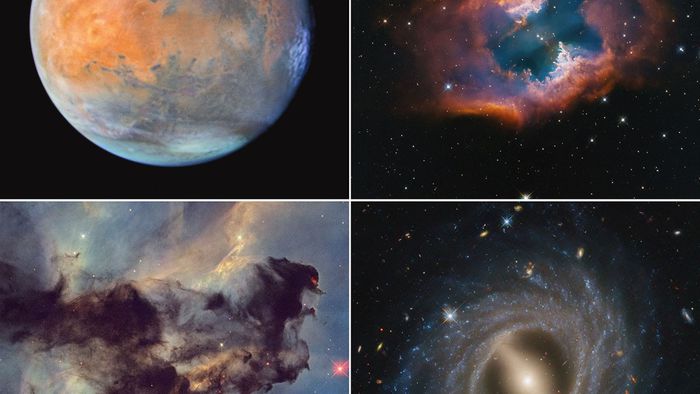
Celebrating 35 years in orbit, the Hubble Space Telescope has released a stunning collection of images captured recently. The photos feature the planet Mars, dramatic images of the birth and death of stars, and a nearby galaxy.
The idea of positioning a telescope above the Earth’s turbulent atmosphere was the key to observing the universe without atmospheric distortion, providing a tenfold increase in clarity compared to conventional telescopes of the time.
Before Hubble, no generation had access to such detailed images of space – now, they’re almost commonplace. Throughout most of human history, the cosmos was largely left to imagination. This changed with the space telescope.
Who named Hubble?
In the early 1920s, astronomer Edwin Powell Hubble, after whom the telescope is named, initiated a marathon with the discovery of galaxies beyond our Milky Way.
Today, leaders of space agencies affirm that Hubble is experiencing a scientific resurgence, thanks to the dedication, perseverance, and skills of engineers, scientists, and operators who have maintained the telescope over the years.
Maintenance and Lifespan
Astronaut crews visited Hubble in five maintenance missions between 1993 and 2009. By extending the telescope’s lifespan beyond its initial 15-year expectancy, the numbers multiply, and the achievements grow:
- The telescope has made nearly 1.7 million observations;
- it has observed approximately 55,000 astronomical targets;
- its discoveries have resulted in over 22,000 articles;
- there have been over 1.3 million citations as of February 2025 – and counting;
- all data collected are archived and currently total over 400 terabytes.
After three decades, Hubble continues to be a household name as the most recognized, requested, and celebrated scientific instrument in human history.
In commemoration, NASA and ESA released images of four astronomical targets, including planets, nebulas, and galaxies. See details below:
Mosaic – A selection of photogenic space targets to celebrate the 35th anniversary of the Hubble Space Telescope.
- Upper left: Mars
- Upper right: planetary nebula NGC 2899
- Lower left: a small portion of the Rosette Nebula
- Lower right: spiral galaxy NGC 5335
Video: NASA explains the chosen images for Hubble’s 35th anniversary
See the gallery for Hubble’s 35th anniversary photos
- Mosaic NASA/ESA
- Mars – These incredible images of Mars were taken by the Hubble Space Telescope between December 28 and 30, 2024, when the planet was about 98 million kilometers from Earth. In ultraviolet light, you can see thin clouds of frozen water that give Mars an even more gelid appearance.
- Nebulosa Planetária NGC 2899 – This marvelous image shows the planetary nebula NGC 2899, resembling a butterfly. It has a diagonal and cylindrical gas flow expelled by radiation and stellar winds. The intense colors come from the brightness of hydrogen and oxygen present there.
- Rosette Nebula – Dark Clouds – This photo shows a small part of the immense Rosette Nebula, a star-forming region about 100 light-years in diameter and located 5,200 light-years from Earth. The contrast between dark clouds of hydrogen gas mixed with dust is impressive.
- NGC 5335 – This spiral galaxy caught my attention! It was photographed in high resolution by Hubble and is known as NGC 5335. It’s a flocculent spiral galaxy with irregular arms where new stars are forming. The structure is as complex as it is fascinating.
Read also:
- Telescópio James Webb finds supermassive black hole that ‘had vanished’
- Chang’e-8 | China presents mission and confirms plans for nuclear power plant on the Moon
Read the article on TechBlog.


